
Posted on July 23, 2025.
Updated on August 5, 2025, at 1:30 p.m.
The Kevin Ryan Campaign wanted to clarify the following:
- Chicago does not use ranked-choice voting; instead, it conducts non-partisan primaries.
- Ryan has also been deployed overseas three times during his military service.
- Ryan was a combat adviser to the Afghan military and other NATO forces.
By Claude Martinez and edited by Nuha Abdessalam.
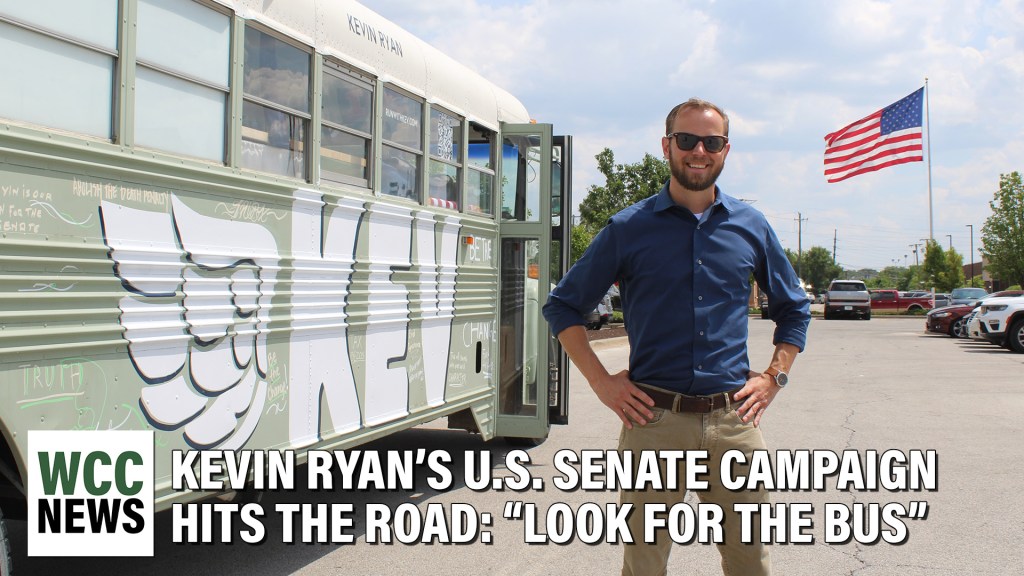
Oak Lawn – “Look for the bus,” said Kevin ‘Kev’ Ryan in an exclusive interview with WCCN on July 2, 2025, as he discussed his candidacy for the United States Senate as a Democrat.
Ryan officially announced his campaign on June 28, entering the race to succeed longtime Democratic Senator Dick Durbin, who announced on April 23 that he will not seek re-election after decades in office.
A native of Chicago’s south suburbs, Ryan grew up in Orland Park, where he attended St. Michael School before graduating from Marist High School. He was also a student-athlete at Marist, where he competed in cross country for three seasons, track for four seasons, and wrestled for three seasons.
He later earned a degree in education from the University of Illinois at Urbana-Champaign and went on to serve in the United States Marine Corps, where he was placed in the Individual Ready Reserve (IRR).
After graduation, Ryan began teaching in Chicago Public Schools (CPS), specializing in history with a focus on Chicago History and Advanced Placement U.S. Government and Politics.
“So I taught everything from 6th-12th grade,” Ryan said. “I first started at a charter school on the south side, in Bronzeville, at Perspectives Math & Science Academy. I taught freshman that year and by September or October this one Junior High classroom, of 6th and 7th graders, ran out two teachers so they said ‘put the marine in there,’ since at that time I was in the Marine Reserve. Then I got deployed [to Afghanistan].”

“While I was deployed, I got a job offer from CPS at Marine Leadership Academy on the West Side, a military JROTC (Junior Reserve Officers’ Training Corps) academy,” said Ryan. “There I taught 9th – 12th. But I mostly taught 10th grade.”
Kevin completed one tour in Afghanistan that lasted from 2019-2020. “We were there during a very interesting time,” said Ryan. “It’s when the first Trump administration entered into a ceasefire, then [they] tried to get a peace agreement. So we had a lot more down time so I spent a lot of that time talking with our Afghan interpreters and it was really cool just getting to know them.”
“Growing up, going to catholic schools you don’t get a lot of exposure to people who practice Islam,” said Ryan. “It was very cool for them to invite me into their community and culture. We had long talks during Ramadan.” Ryan happily stated “There is something poetic about a south side Irish catholic kid sitting in the middle of an ideological war with a Pashtun Sunni Muslim just talking about God. We can get along but why can’t everyone else?”
“Like I said, operations slowed down during the middle and the end of my deployment. I had the chance to read the Quran,” said Ryan. “Reading it helped me better understand the Afghans we worked with.”
That stuck with him. Before he returned home, Ryan gave each of his six interpreters a copy of the U.S. Constitution, along with a message that said: ‘I can’t wait for you to become an American citizen.’
“And they in turn, there were six of them, gave me their only sole copy of the Quran and it was written in both Arabic and Pashto. It was beautiful. I still have it. That was a very good take away from Afghanistan,” Ryan stated.
After his deployment he attended the University of Oxford, England, graduating with a degree in Diplomacy which focused on international law, international finance, international politics and diplomatic practices. “It basically was training to become a diplomat,” Ryan said. “It was an incredible help to learn all those different nuances and become literate in all the aspects of international affairs.”
Later he attended Georgetown University, D.C., and earned a degree in Security Studies with a focus in intelligence. “It was mostly U.S. centric [focusing on] national security and intelligence operations.”
“I worked for the Commandant of the Marine Corps,” said Ryan. “When you get to those senior levels, to the General of the entire Marine Corps, it’s very interesting to see how things unfold and about what happens at the top. My biggest takeaway from it was we are all human and we kind of forget that sometimes. Generals are just humans too.”
He then enthusiastically described how he and his department managed the general’s orders while at the Pentagon. “The best metaphor is that generals are like a stegosaurus. The head is just a [small] part of it, but it has this HUGE body and a SUPER long tail; and if the general moves its head, it can knock over everything the head is not seeing. So the job of the staff is to make sure the tail is not having unintended consequences. I really got an inside understanding of how our government works; from the National Defense Authorization Act (NDAA) to the national Defense Appropriations Act (DAA) and how those things feed into what the Pentagon churns and pumps out – what comes to defense spending.”
Before transitioning back into the reserves he would reach the rank of Major. As a civilian, he served with the U.S. Department of the Treasury and was a member of the Committee on Foreign Investment. A GS-13 position.

With a clear understanding of Ryan’s background and deeper insight into his experiences in the classroom, at university, and in military and government leadership roles, WCCN asked Kevin ‘Kev’ Ryan about everything from campaign finance to foreign policy. In his own words, here’s what he said.
If elected, what is one of the first pieces of legislation you would prioritize or introduce?
“Oh, that’s easy. The first thing I would introduce is a joint resolution to amend the Constitution to authorize or assert Congress’s right to establish spending limits on political contests.
That is the most important piece of legislation that we have to pass.
Now, people will say, ‘Oh, it’s impossible to amend the Constitution in today’s climate.’ I say we don’t have a choice. The way that the cost of our elections is going, even look at what just happened in the Senate (referencing President Trump’s Big Beautiful Bill; which passed the Senate on July 1). They’re cutting spending to working-class families and giving tax cuts to the ultra-wealthy. This is a perfect example of money controlling our government.
So the first thing I would do is introduce a joint resolution. But I wouldn’t just introduce it, because a lot of members of Congress introduce hundreds of bills every year. They might get a handful passed through their house, respectively, and then maybe one or two will become public law signed by the president.
I will make it a point to get its two-thirds passage through both houses, and then ratified by three-fourths of the states. That is what we need to do.
And that guy up there, Senator Joseph Bristow, is my inspiration for that.”

“He was a progressive from Kansas back in the Republican Progressive Era. And he campaigned on amending the Constitution for the direct election of senators, because at the time, senators were chosen by the state legislatures. He saw deep corruption in the state legislatures, and he wanted to change it. So he campaigned on it. He won.
And then, in a single term, in six years, he introduced the joint resolution, got it passed through both houses, and saw to it that it was ratified by the states. And then he lost reelection.
But in one term, in a single term, he didn’t have to be in Congress for 40 or 50 years. He had to be there for six years. And because of that, he gives me the opportunity to appeal to you and the people out there directly. Instead of going to the parties of the state legislature and appealing to them to get elected to senator.
He changed the Constitution single-handedly. And we can do it.
The last amendment that lowered the voting age to 18 passed in 100 days, from the time that it was dropped in the hopper to the time the last state ratified it.
One hundred days.
And that’s why that’s absolutely the first thing that I will do.”
How would you help small businesses?
“I think a big way is to remove barriers for small businesses by removing taxes, fees, administrative costs, and administrative barriers just to streamline the process. I think we treat small businesses like corporations, and that is not fair or effective.
Reducing taxes on small businesses, while equally raising taxes on ultra-wealthy individuals and corporations to offset those costs.”
How would you support family farmers in Illinois? Would your plan be similar to how you’d help small businesses? For example, by pushing back against large corporate farms?
“Well, I think that’s like one of the biggest ways to help the family farmers and independent farmers, equally to small businesses, is to further regulate and prevent the continued expansion of these big corporate farms that are just taking up more and more land. And, being able to operate at such an efficient level that these small, independent farms can’t keep up with…, the way they reduced prices.
So I, it’s like it almost goes back to, you know, the 1860 Republican platform. And they were all about the Homestead Act, about giving independent farmers these tracts of land to prevent these huge moneyed interests from out East coming in and just buying up these huge swaths of land and then turning these farms into these just corporate powerhouses.
I see something similar to that. We need to regulate to ensure that land is capped with small, independent farmers, and that they can — that we can keep the playing field level so that these larger corporations and corporate farms can’t come in and upset the economic balance by basically outpricing these smaller farmers.
When asked about the Palestine-Israel conflict and why Palestinian and Arab American voters should support him, Kevin Ryan referenced his experience in Afghanistan, stating:
“Having studied international law at [University of] Oxford, England, and having been taught infantry tactics in warfare, it’s been very clear that there has been a disproportionate use of force in Gaza.
It’s not acceptable.
I know you want to tie that into my interactions with… my Afghan partners [and] how that helped me connect with different communities here.
I think it made me more human. Like, just like whenever we expand our boundaries and meet new people and get out of our comfort zones, we become more fully human and our empathy grows. I think in that sense, because I’ve been able to develop that human empathy, I think I can connect with a lot of people, regardless of where their backgrounds are.”
On your website, one of the issues you list is term limits, specifically capping the age for U.S. senators at 75. Why is that so important to you?
“First we have to look at what the problem is. The problem is not necessarily that people are serving for a long time. If our democratic institutions functioned properly, we don’t need term limits or age limits. And that’s why they’re not in the Constitution. That’s why even the presidential term limit wasn’t in the Constitution. We had to amend the Constitution to do that.
So when it functions properly, the people choose, and that’s how it’s supposed to work. But it’s not functioning properly now, especially with the party control of primary elections.
So, I mean, in Illinois, in the state legislature in the last election, 2024, half of the state legislature, both the House and the Senate, did not face an opponent in either the primary or the general election. They just got their signatures to get on the ballot, and then they needed to vote for themselves and they got elected.
That’s not a democracy. When half of your state legislature just automatically gets appointed.
So that’s one example. The party controls the primaries. To fix that, we need nonpartisan preliminary elections, kind of like what we saw in New York City. That was still a party primary, but at least they had ranked choice voting.
I would like to see what we do in Chicago. Nonpartisan, ranked choice voting, so you can choose, you know, amongst your favorite candidates. And it’s everyone together instead of having to choose one or the other.
I talk to so many conservative voters who say, ‘Well, I just hate how when we go to vote on primary Election Day, I have to choose a Republican or Democratic ticket. What if I wanted to vote for a Republican here and a Democrat here?’ Yes, you should be able to do that.
So that is really the real solution to reforming our elections or to make our democratic processes work: using nonpartisan preliminary elections with ranked choice voting. That is a long-term solution.
Short of that, if we can’t get that, I think then the next solution would be something like age limits, so that we avoid what we’ve had this year. I can’t remember how many members of Congress died in this last session, but it was like, I think three or four while in office. And that’s whittling away the Democratic Party’s majority.
That shouldn’t be the case. You shouldn’t be clinging on to your position when you clearly should retire. I mean, we look at retirement ages across different industries.
I mean, pilots, I think they have to retire at 60. Generals have to retire at 64. We say our generals are too old if they are 65, 66, or 67. Yet the average age of the United States Senate is 64.
So the same age for retirement for generals is the average age for the United States Senate. What’s the difference between these two things, and why does one have to retire and the other doesn’t? Well, maybe because one writes the rules, right? Of course they don’t want to make themselves retire.
But that’s why I think age limits, I support age limits. Because we already have them. I think around 30 states have age limits for their judges. So there’s already precedent for it.
And I think it’s a good short-term, achievable thing that we can get before trying to enact the larger long-term reform that we need, of nonpartisan preliminary elections using ranked choice voting.”
With the United States burdened by a national debt exceeding $36 trillion (U.S. Department of the Treasury), why is it important to reduce this debt, and how can voters trust that you will take meaningful and effective action to address it?
“Well, because we don’t have a choice. We need to. In our lifetime the national debt has compounded in credit. So much of our annual fiscal budget goes towards interest on the debt. And it keeps growing. And that’s why it’s a problem.
So last year we spent somewhere around 870 billion, something like 860 billion on defense. We spent 880 billion on the interest of the debt alone. So we’re now spending more on the interest on the debt every year than we are on defense. That is a problem.
That’s 880 billion dollars that we could be investing in education or health care or any other service that is good for the American people. Instead, we’re just wasting it on these interest payments.
But we have this problem not because we have a spending problem. We have a taxing problem.
Because when we look at the federal budget, we look at the size of the discretionary budget compared to the mandatory spending. That is a small sliver of the budget. And then it’s about a third. And you cut that in half, half of it is defense and half of it is discretionary non-defense spending.
So unless you want to cut and completely stop Medicare, Medicaid, the Veterans Health Administration and the other types of mandatory spending that we have that takes up the majority of our budget… That is what they mean when they think we have a spending problem, if you think we have a spending problem, that means that you don’t want people to get Medicare. You don’t want people to get Medicaid. You don’t want people to get Social Security, because that is what is taking up the largest chunk of our federal budget.
We do not have spending from people who deserve those things. They need those things. And the wealthiest country in the world should be able to provide those things.
We have a taxing problem because we allow ultra-wealthy individuals and corporations to send their money overseas. To evade taxes. We just, we are giving them tax cuts or Republicans are trying to give them tax cuts. With this current bill (One Big Beautiful Bill Act) that is going through, we don’t tax wealth.
So if we just did those things, if we closed the offshore loopholes, if we started taxing wealth, well, just even at one percent for everyone who owns 50 million dollars or more, then we could start fixing the problem of the national debt. Then we can start paying it. Because that is the problem. It’s not the spending that’s creating this. It is the lack of revenue.
We are spending on the things we should be spending on. But Republicans don’t want to pay for it. They don’t want to pay for people’s Medicare and Medicaid, Social Security. That is what they mean…
I think that is a critical difference between Republicans and me. Because we both agree that there is a national debt problem, and I wish that more people would agree to that or see the problem as it is.
But where I differ from conservatives is that they see it as a spending problem. I see it as a taxing problem. And the way you look at that problem, I think, says a lot about who you care about.
If you think we have a spending problem, you do not care about the American people. If you think we have a taxing problem, you do.
If you think we have a spending problem, you care more about making sure that those who should be paying their taxes, the ultra-wealthy individuals and corporations that are not, you care more about them.
And you know what? I would take a guess that they are probably the ones that are funding their campaigns. And that is why it all goes back to the whole purpose of this campaign and the whole purpose of my first bill that I would introduce a joint resolution to Congress amending the Constitution to establish spending limits on political contests.
We have to take money out of politics so we can start electing people who recognize, yes, there is a debt problem. And yes, it is a taxing problem. It is not a spending problem.
We are spending on the American people. We should be spending on the American people. But in order to do that, we have to tax the incredible wealth that this country possesses instead of letting it stay in the top one percent of the country.”
As a veteran, why do you believe it is essential for veterans to have access to VA hospitals and quality medical care in the United States?
“I mean, it’s incredibly important. It’s a fundamental right for everyone to have access to health care. And again, the wealthiest country in the world should not struggle over providing a basic right like that.
But for veterans, it becomes a little bit more, it becomes more visceral because in order to receive veterans health care… Any veteran can apply for it… If you’re getting veterans health care provided at a low or no cost, that’s because you have some kind of service-related issue.
So, something that happened during your service where you need to take care of, and the government saying, ‘We’re going to provide that for you.’ So if someone lost a limb in combat, you know, their life has been fundamentally altered because the president and Congress sent this person to war and they lost their limb. And so the government said, ‘Well, we promise to take care of you. We will take care of your healthcare because of the sacrifice that you gave.’
And so obviously, everyone, like I said, deserves to have access to health care. But when you start denying it to the people who put their life, [limb,] eyesight, and mental health on the line in wars that they may or may not agree with because their government sent them there and then the government is going to say, ‘No, you don’t get health care,’ that’s a certain level of evil that should not be tolerated.
As the United States of America, what should our stance in the world be? Should we focus on helping those in need abroad, prioritize supporting our own citizens first, or pursue some other approach?
“So I think a great way to answer that question, or to look at that question, is: What kind of world do you want to live in? What kind of neighborhood do you want to live in? Do you want to live in a neighborhood that is marked by chaos, uncertainty, and violence? Or do you want to live in a neighborhood that is safe, secure, and prosperous? I think most of us would choose the latter.
When it comes to foreign policy, the United States is in a very unique position because of its tremendous wealth and military might. And so you can ask yourself: Would you prefer to live in a world marked by chaos, uncertainty, and danger? Or would you want to live in a world of stability, peace, security, and prosperity? The United States built and strove to build that type of world in the postwar period and made large successes. People wanted to come here. They wanted to wear Levi’s blue jeans. They wanted to be American. And many people still do because we have so much prosperity and opportunity here.
When we went abroad, we did not wave our hands in the air and chant ‘USA!’ We came as partners in good faith to help uplift the world. Because just as we should uplift our neighbors and make safe, stable, secure, and prosperous communities in our own neighborhoods, the United States can and ought to do that abroad. We, as a people and as a country, are more secure and prosperous when the whole world is thriving and living in security, prosperity, and democracy. And with our liberal values like the rule of law, individual liberty, and democracy, the world becomes a more prosperous, safer, and better place for everyone. So I think that is what our foreign policy should be.
The Trump administration is taking us in the complete opposite direction. They wave their fists in the air, saying, ‘You don’t pay your fair share.’ Where are the big contributors? That’s embarrassing. Like, do you really need Belgium or Luxembourg to pay 5% of their GDP to defense? Is that going to make you feel better that they spend a couple million more on defense compared to our $860 billion budget? And then what do you lose in that? The relationships you have with those people and how it makes us look on the national stage?”
As a former history teacher, why do you think the men and women whose photos you’ve displayed in your bus are so important to you and to America? And why is it crucial for both older and younger generations to remember their legacy?
“That is a beautiful question. Because when we look back in history, when we read history books and watch movies about times that happened in history, it’s almost as if ‘history just is’. Abraham Lincoln just was, you know, he emancipated the slaves and kept the Union together. We lose sight of the humanity of these individuals at certain points in history, and that history has never been, nor will ever be, static. We are not where we are today because people receded into passivity and stayed on the sidelines. People like this, everyone up in here, they defied the status quo. They said no, this is unjust. We must and can change this. And they strove to do it.
Every single person in here, they saw, like John Logan up there. He’s an Illinois man. He started off as a Democrat, you know, like a pro-slavery Democrat. Then once the Civil War broke out, he made a complete 180, joined Lincoln, and became a radical Republican, staunch abolitionist who, along with Thaddeus Stevens over there, led the radical Republican cause for the first Civil Rights Act. They passed the first Civil Rights Act, I think it was in 1867, but the Supreme Court struck it down as unconstitutional. That set us back 100 years until Dr. King and all the other civil rights leaders had a march to get those rights reinstated.
One hundred years.
We had it because people said no, this is wrong. ‘Equality now.’ Every single one of these people looked at the world and said, this is not just. They strove to make a difference, to make it better. And that is what I’m doing because I see just how in Lincoln’s time slavery was the great injustice. The great injustice of our time, of our generation, is the barter and butcher of our elections through unchecked spending. We have to do something about it.
And so all of the incumbents who are in office right now who say ‘they own Citizens United’, but then don’t lift a finger to actually do anything about it; we don’t need those people. We need people like this, people who stand up and say, this is unjust, and we need to do something about it. We cannot sit by. That is what is important.
My political career is not important.
No one’s political career, first of all, is important. I don’t want to build a career. If I did, I would probably go for something like the Water Reclamation District and make my way up to the Cook County Democratic Party.
But I don’t want a career. I want change because we need change. We need it, and we need people like these people who see that yes, we need change now; not to sit on the sidelines.
And so that’s why these people are up in the sky. And that’s why it’s important to remember history. Like Alice Paul, who fought for the 19th Amendment to get women the right to vote.

This is her toasting the ratification of the 19th Amendment with grape juice, of course, because she was also a leader in the Temperance Movement. She was tortured in prison by the hands of the United States government, all because she wanted the right to vote. Do you think she cared about some prestige or perk or office? No. She saw an injustice and wanted to correct it. And she did. She helped lead the movement to correct it.
That’s why these people are up in the sky. Same with Harvey Milk over there. These are all people who saw the world one way and said no, we must do something else. That’s why history is important to remember that these people had choices.”
What sets you apart from all the other Illinois candidates running for the United States Senate, and what would you like to say in your closing statement?
“What makes me different from every other Democrat, Independent, Republican, or otherwise. Anyone who says that we need to take money out of politics. The difference is that I truly believe we will not do it until we find a new path to success. And that’s what this bus, that’s what this campaign, is about. Because we’re not going to raise tens of millions of dollars to send ads in people’s faces. We’re not going to pay for advertising or media.
We’re going to take this bus. We’re going to travel across the state to all 102 counties. We’re going to meet with voters in this office, not in their homes and not where they work. And we’re going to connect them with these ideas and prove that you do not need to spend tens of millions of dollars to win an election.

And when we prove that new theory of success, then we can look everyone else in the eye and say, see, you are wrong. You don’t need to do this. You think you have to because you lack the creativity to see a new solution. And those are the people we need out. Everyone who lacks the creativity to see how we can make our future better. We need them out.
We’ve seen new people with the imagination and the creativity and the temerity to challenge the status quo in new ways.
For more information about Kevin ‘Kev’ Ryan’s campaign, visit his website: runwithkev.com.
WCCN is a nonpartisan online publication.
Other candidates interested in completing an interview may contact WCCN through our website.
For more news follow us on Facebook, Instagram & YouTube @ Will Cook County News.

James McGahan’s Big First Inning Lifts Cardinals Past Cyclones
By Claude Martinez. Blue Island — It was a complete team effort as the Dwight D. Eisenhower Cardinals defeated the Chicago High School for Agricultural Sciences Cyclones 16-1 on March…


Chicago Christian Earns First Win Under Grevengoed
By Claude Martinez. Palos Heights — Opening day for the Chicago Christian Knights became even sweeter as they earned their first win of the season under their new head coach.…

Trinity Christian Tops Calumet College in Final Season Push Behind Thompson
By Claude Martinez. Palos Heights — Trinity Christian defeated Calumet College 3-0 on March 24 at DeVos Gymnasium. With the college set to close in May, the Trolls are playing…
Something went wrong. Please refresh the page and/or try again.
 Will Cook County News
Leave a comment